There’s a particular kind of curiosity that only hybrid engineering can ignite—the sort of wondering how a familiar vehicle concept might be re-performed with unfamiliar hardware. Mazda has long lived at that intersection, where engineering tastes like philosophy and philosophy finds its way into the spec sheet. So when the conversation turns to a “Mazda3 – Rotary Range Extender EV?” idea, the question isn’t merely whether it could work. The real question is what kind of experience it would create, how it would behave in the daily ritual of driving, and whether rotary regeneration can be made to feel modern instead of anachronistic.
The notion of using a rotary engine as a range extender for an EV carries an almost theatrical promise: the quiet confidence of electrification, paired with a compact onboard energy generator that doesn’t demand constant refueling. But technology rarely arrives in a single straight line. It arrives as compromises, thresholds, thermal management strategies, and calibration decisions that either elevate the concept—or quietly undermine it.
What a “Rotary Range Extender EV” actually means
A range extender is not the same thing as a traditional hybrid powertrain. In a conventional hybrid, the engine and motor coordinate to deliver propulsion in varying proportions. In a range-extender EV, the primary motive force is electricity, delivered by electric motors. The engine’s role is more specific: it generates electricity (or charges a buffer) once the battery’s state of charge reaches a predetermined threshold.
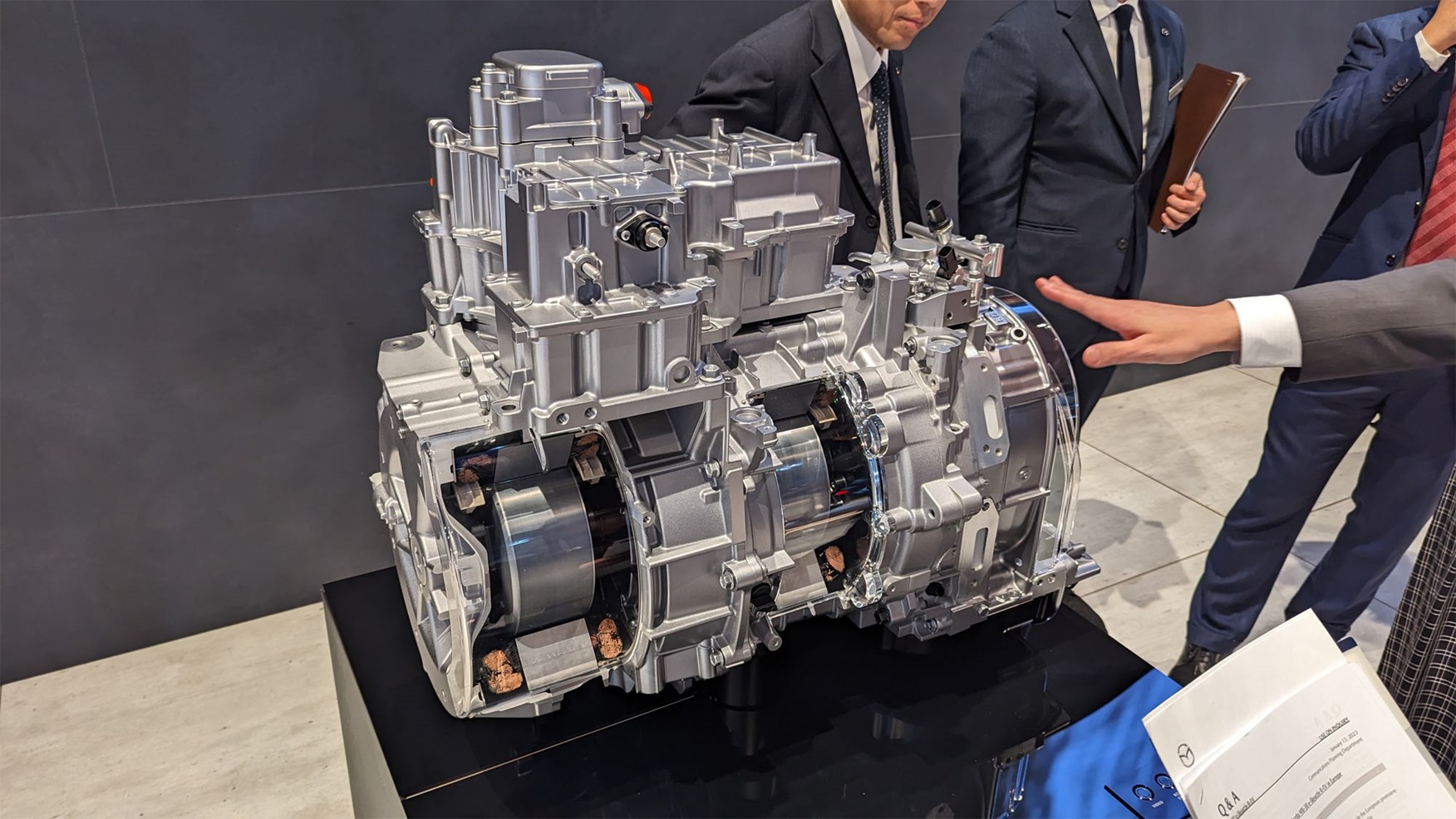
In the rotary version of this idea, Mazda’s compact rotary engine would function like a roaming generator. The EV driving experience would remain largely electric—smooth torque onset, low-speed serenity, and a dashboard that doesn’t continuously nag about engine behavior. Yet the rotary unit would periodically awaken, typically at points calibrated to keep emissions control within its most cooperative operating window.
To put it simply: when the battery is full, you’re driving an EV. When the battery dips, the range extender becomes a background musician—audible only when the performance requires it.
Why the rotary engine is an unusual but compelling candidate
Rotary engines are often discussed with reverence and caution in the same sentence. Their geometry differs from reciprocating pistons, and their engineering character—balance, lubrication needs, and thermal patterns—creates both opportunities and challenges. Mazda’s history suggests the company understands those nuances rather than treating them as obstacles.
For a range extender, compactness matters. A rotary’s packaging potential can be attractive when the goal is to keep the generator small and light relative to a conventional engine capable of producing comparable electrical output. There’s also the matter of response: a rotary can be tuned to generate power with fewer mechanical transitions, which may simplify the control strategy when the engine is only expected to run in certain bands.
Still, rotary suitability isn’t automatic. Fuel efficiency, durability under prolonged generator duty cycles, and emissions compliance require deliberate calibration. A range extender is not a “start-stop commuter engine” that idles briefly and then surrenders. It can run steadily for longer intervals. That means the rotary would need to be optimized for sustained operation, thermal stability, and longevity under emissions-critical conditions.
Powertrain architecture: how propulsion remains electric
The most satisfying versions of a rotary range-extender EV are the ones that preserve the feel of electrification. That means the motor(s) should handle all traction duties, including high-torque launches and dynamic acceleration moments. The engine-generator’s output should primarily feed the battery’s charge buffer and the inverter demand—not chase the road directly.
In practice, this usually implies a layered energy flow: regenerative braking returns energy to the battery; the electric motor consumes it; when the battery falls, the engine-generator activates to restore charge. Control software orchestrates this ballet, deciding when to bring the engine online, when to keep it off, and how to blend generator output with battery buffering so that drivers don’t feel abrupt interruptions.
The key is smoothness. A range extender can remain conceptually “invisible,” but only if acoustic and torque transitions are well managed. Even a small delay in engine start can show up as a brief power dip, so the system must anticipate consumption and begin charging before the battery reaches a precarious threshold.
What changes for Mazda3 drivers—day-to-day reality
A Mazda3 is defined by more than power. It’s defined by a particular interpretation of steering feel, chassis response, and a cabin that tries to be calm even when the road gets busy. The question is whether a range extender EV variant would preserve those characteristics while adding a new kind of energy management.
In city driving, a range extender Mazda3 would likely behave like a conventional EV for much of the time. Stoplights become opportunities for regeneration rather than for engine idling. Short trips become battery-driven. Only when the driving pattern and battery capacity converge—especially after prolonged highway runs or repeated acceleration bursts—would the generator start to hum in earnest.
On highways, the range extender could become more frequent. Yet the goal should be steady, not frantic. A well-calibrated system would run the rotary at a near-constant efficiency point, using the battery as a shock absorber for real-world fluctuations. That approach reduces the need for the generator to constantly chase the instantaneous demand.
Range anxiety, but engineered: charging vs. refueling
Range anxiety is often framed as a psychological burden. But in engineering terms, it’s a question of predictability: can drivers anticipate how far the car will go, and can the system recover after energy is depleted? A range extender EV doesn’t eliminate refueling needs entirely—rather than filling a battery at a charger, drivers would fill a fuel tank for the generator.
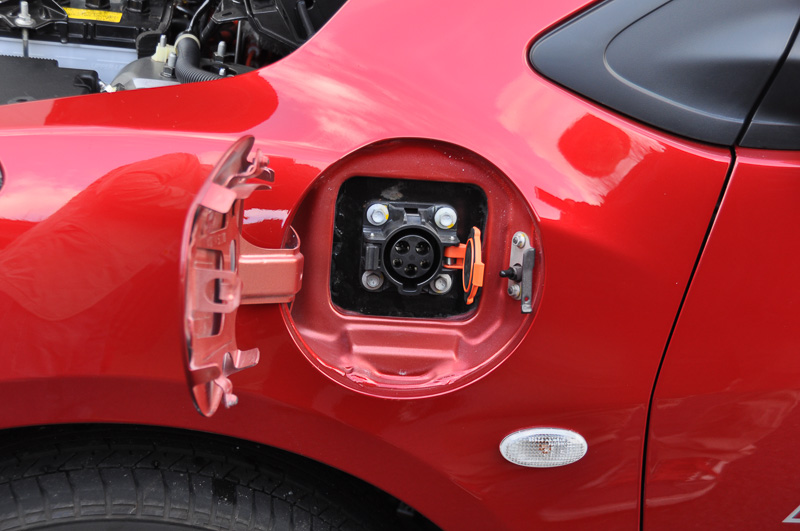
This hybridized ecosystem brings an interesting compromise. Charging may still be recommended whenever convenient, because a charged battery improves responsiveness and reduces engine runtime. Meanwhile, the range extender provides a safety net—especially for longer commutes, road trips, or areas where charging infrastructure is limited or unreliable.
For readers, the most practical questions become: how quickly would the system recover to a comfortable battery state, what is the expected engine runtime frequency, and how does the vehicle communicate that information to the driver? A great dashboard tells the truth without overwhelming the driver with graphs.
Sound, vibration, and the “ethos” of quiet
EVs are cherished partly for silence. Introducing a rotary range extender inevitably introduces mechanical presence. The best possible outcome is not total silence, but controlled, purposeful sound—engine activity that feels like a background service rather than an interruption.
Rotary engines are known for a distinctive character. In generator form, the acoustic signature could be masked through insulation, mounting strategy, and calibration. But the driver will still notice when the engine transitions from off to on. That means Mazda would need to make the behavioral logic intuitive: consistent activation thresholds, minimal oscillation, and no chaotic “on-off cycling” that feels like indecision.
Short and long sentences can mirror the customer experience here: the transition should be “short” and confident, not drawn out and uncertain. When designed well, the rotary’s emergence should feel like the car taking responsibility.
Efficiency and emissions: the calibration battleground
Efficiency is where the concept either becomes persuasive or collapses under scrutiny. An EV that carries a generator can still be efficient, but only if the engine runs in its most favorable range and only as needed. If the rotary operates inefficiently—too frequently, too irregularly, or at suboptimal loads—the system could lose the energy advantage that makes EVs compelling.
Emissions control is equally delicate. Even if the generator runs intermittently, it must comply with modern standards across temperature, altitude, and operating cycles. That requires catalysts, careful thermal management, and fuel quality sensitivity analysis. Mazda’s engineering heritage suggests a strong capacity for iterative refinement, but readers should understand: compliance is a moving target, and generator duty cycles are different from typical engine use.
Different ways readers can engage with the topic
To explore a Mazda3 rotary range-extender EV idea thoroughly, readers benefit from multiple content angles. Some may prefer technical explainers that map energy flows from battery to motor to inverter. Others might want user-centric scenarios—how the car behaves on a commute, on a winter morning, or during a road trip with uneven charging opportunities.
There’s also room for comparative discussion: how this concept stacks up against battery-only EVs, traditional hybrids, and conventional plug-in hybrids. A persuasive article would include “what it feels like” alongside “what the numbers say,” because ownership satisfaction is measured in moments, not only charts.
Finally, a thoughtful approach should consider skepticism. Readers may wonder about complexity, long-term serviceability, and whether a rotary range extender is a clever bridge or a transitional detour. These questions deserve direct, coherent answers—especially around durability, maintenance expectations, and system integration.
Is it the right direction for Mazda3?
The Mazda3 is an emblem of mainstream relevance. A rotary range extender EV variant would need to be more than a technical curiosity—it would need to feel reliable, intuitive, and consistent with Mazda’s brand of driving. If the generator strategy is stable, emissions are compliant, and the vehicle retains EV-like smoothness, the concept could become a compelling middle path between battery dependence and refueling certainty.
But the concept succeeds only if the engineering eliminates the “gotchas”: abrupt transitions, inefficient runtime behavior, frequent engine restarts, and confusing driver feedback. The rotary’s role must remain purposeful—an energy ally rather than a complication.
The road ahead: what to watch for
As the idea develops, key indicators will include real-world efficiency under highway loads, the frequency and duration of generator operation, and the degree of cabin acoustics control. Also watch for transparency in driver information—clear messaging about when the range extender will likely run and how much energy remains available for pure-electric driving.
Just as importantly, readers should look for evidence of durability strategies tailored to generator duty cycles: lubrication approach, cooling architecture, thermal cycling mitigation, and service interval logic. A range extender EV is a system designed for repeatable behavior, not one-off demonstrations.
In the end, a “Mazda3 – Rotary Range Extender EV?” is a story about balance: the electrified soul of a battery car, paired with the pragmatic insurance of an onboard generator. If executed with discipline, it could offer drivers something rare—less compromise in the moment, more certainty over the journey.
Whether it becomes reality or remains a fascinating what-if, the concept invites a deeper appreciation for how far modern powertrain thinking can stretch. Quiet can coexist with energy independence. Efficiency can coexist with extended freedom. And engineering can still feel, in its own measured way, like a narrative worth following.