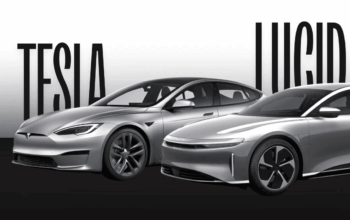
Two sedans stand at the edge of a modern boulevard, each one humming with a different philosophy of speed. The Tesla Model 3 Performance arrives like a sleek blade—quiet, deliberate, and suddenly decisive. The BMW i4 M50, by contrast, moves with the confidence of a well-trained orchestra: precise, cultured, and engineered to feel like motion with manners. Between them lies a debate that is less about numbers alone and more about how a driver wants the road to feel when the lights flick from ordinary to electric.
Think of the Model 3 Performance as a comet tucked into a minimal suit. It doesn’t announce itself with drama. It simply appears, accelerates, and leaves a bright afterimage behind. The i4 M50 is a grand touring violin—still capable of fireworks, but also devoted to timbre, balance, and the subtle harmonics of a well-set suspension.
Reputation, Identity, and the Meaning of “Performance”
Performance is not a single dimension; it’s a philosophy. Tesla treats performance like an equation that can be iterated until it becomes intuitive. The Model 3 Performance leans into responsiveness, tight control, and a throttle mapping that feels almost telepathic. You don’t “manage” the car so much as coordinate with it.
BMW frames performance as a blend of engineering discipline and driving pleasure. The i4 M50 wears its sporty intent with restraint, delivering a sense of composure that feels familiar to anyone who’s loved Bavarian chassis tuning. It’s not just fast; it’s articulate.
Both cars court thrill, yet their personas differ. One is a digital pragmatist. The other is a mechanical poet.
Acceleration Feel: Instant Sparks vs Orchestrated Surge
In pure launch terms, both can leap forward with a kind of immediacy that interrupts thought. Still, the character of that shove diverges. The Model 3 Performance tends to feel like a sudden opening of a sealed door—traction appears and the horizon stretches. The power delivery is direct, with minimal delay between intention and outcome.
The i4 M50 tends to feel more “shaped.” Its thrust can be forceful, yet it’s filtered through a framework of control that emphasizes stability and repeatability. The result is acceleration that feels confident rather than merely aggressive.
Short trips can turn into rituals for both. The difference is in the sensory drama: Tesla feels like raw velocity in a streamlined jacket; BMW feels like power delivered with a steady hand.
Handling and Chassis Personality
A fast car is only half the story. The other half is how it behaves when the road stops cooperating—when the lane narrows, when the corner tightens, when the surface turns slightly slippery.
The Model 3 Performance often communicates via its steering and body control. It feels agile in a way that can surprise drivers who expect electric cars to be only quick in straight lines. Turn-in typically feels crisp, and the car seems to invite corrections rather than punish them. Short, clean inputs make it respond as if it’s reading your wrists.
The i4 M50 brings BMW’s hallmark: a balance between firmness and forgiveness. It’s designed to feel planted, with traction that encourages you to press the line rather than retreat from it. The suspension tuning tends to prioritize confidence over raw twitchiness, which can be a gift on longer drives.
In metaphor, the Model 3 Performance is a nimble dancer who leans into rhythm. The i4 M50 is a practiced athlete who chooses the optimal angle and holds it.
Braking, Regeneration, and Pedal Logic
Electric driving isn’t only about speed; it’s about deceleration craftsmanship. Regenerative braking can feel like a translation layer between kinetic energy and control.
The Model 3 Performance often delivers regen in a way that supports smooth one-pedal driving. The pedal can feel like a dimmer switch for momentum, letting you modulate slowdown with precision. That can make city traffic less tiring and highway descents more composed.
The i4 M50’s braking approach tends to feel polished and predictable, with regen that integrates into the overall pedal feel. BMW’s calibration often aims for a seamless transition so drivers aren’t forced to recalibrate their expectations mid-drive.
For both, the best part is confidence. For Tesla, it’s immediacy. For BMW, it’s refinement.
Cabin Atmosphere: Digital Minimalism vs Bavarian Comfort
The cockpit is where performance becomes emotion. The Tesla interior frequently favors minimalism and a sense of focus—information presented with directness, screens that feel like instruments rather than clutter. The experience can feel like being in the command center of a spacecraft, where every control has a purpose.
The BMW i4 M50 usually offers a more traditional luxury layout. Even when the car is electric at its core, the cabin can feel familiar: sculpted materials, familiar driving ergonomics, and an overall atmosphere that says comfort isn’t an afterthought. It feels like a lounge with a performance heartbeat.
Choose your metaphor. Tesla offers the sleek laboratory. BMW offers the well-appointed study.
Range, Efficiency, and the Reality of Everyday Miles
Range matters because roads are rarely polite. Weather, speed, and terrain act like unpredictable variables in a long equation. Both cars are capable, but they wear their efficiency differently. Tesla often feels optimized for real-world usability—its software ecosystem and route planning are designed to reduce friction and increase confidence.
The i4 M50 can feel similarly practical, especially with its energy management and comfort-focused design. While the driving experience leans premium, the electric nature still supports the essentials: smooth cruising, manageable consumption, and dependable performance from day to day.
In the end, the question becomes: do you want your efficiency delivered as a system that anticipates you, or as a luxury routine that stays steady no matter the mood of the road?
Charging Convenience: The Fast Lane to Daily Confidence
Charging is the bridge between aspiration and routine. A performance EV that can’t recharge quickly when it’s needed becomes a promise with footnotes.
Tesla’s approach often centers on streamlined charging behavior and an ecosystem that encourages planning without overwhelm. The experience can feel less like “where do I plug in?” and more like “the car will handle it.” That matters when life is busy and time is tight.
BMW’s ecosystem can also be robust, particularly depending on region and charger availability. It emphasizes integration with the broader BMW lifestyle, aiming for a seamless transition between navigation, charging guidance, and driver experience.
Both want your energy to be predictable. Tesla tends to chase simplicity. BMW tends to chase polish.
Technology and Driver Experience: Software Versus Engineering Drama
In a Tesla, software feels like the chassis of the mind. Updates, interfaces, and driver-assistance features create a sense that the car is continually refining itself. The result is a feeling of momentum not just from acceleration, but from evolution.
In BMW, technology often presents as a layer on top of engineering heritage. The i4 M50 can feel like a car where the hardware insists on being respected, while the software supports it—responsive but grounded in a driver-first philosophy.
This is where the comparison becomes philosophical. Tesla leans toward adaptive intelligence. BMW leans toward crafted control.
Ownership Appeal: Which Story Fits Your Life?
The Model 3 Performance tends to appeal to drivers who want immediacy, software clarity, and a performance feel that’s both modern and direct. It suits people who enjoy learning the car, then trusting it. It’s ideal for those who like their excitement clean, efficient, and just a little futuristic.
The i4 M50 tends to appeal to drivers who want speed with composure, luxury with structure, and a driving experience that feels like a long-standing relationship rather than a new device. It suits people who enjoy refinement—who want performance without the feeling of being handheld by technology.
Metaphorically, the Tesla is a thunderstorm in a minimalist suit—powerful, immediate, and startling in its clarity. The BMW is a well-tuned race engine tucked inside a luxury sedan—its power is present, but the ride keeps its manners.
Conclusion: Two Paths to the Same Rush
The Tesla Model 3 Performance and the BMW i4 M50 both chase the thrill of electric speed, but they do it in distinct dialects. Tesla speaks in immediacy and crisp coordination. BMW speaks in balance, comfort, and engineered poise.
If you crave direct response, minimalist focus, and a performance feel that’s almost instantaneous, the Model 3 Performance will likely feel like a key turning in a lock you didn’t know you had. If you crave refinement, composure, and a luxury-forward performance experience that remains composed under pressure, the i4 M50 can feel like an invitation to drive with confidence rather than urgency.
In the end, it’s not simply “which is faster.” It’s which kind of excitement you want to carry home—the comet’s clean strike or the violin’s resonant swell.