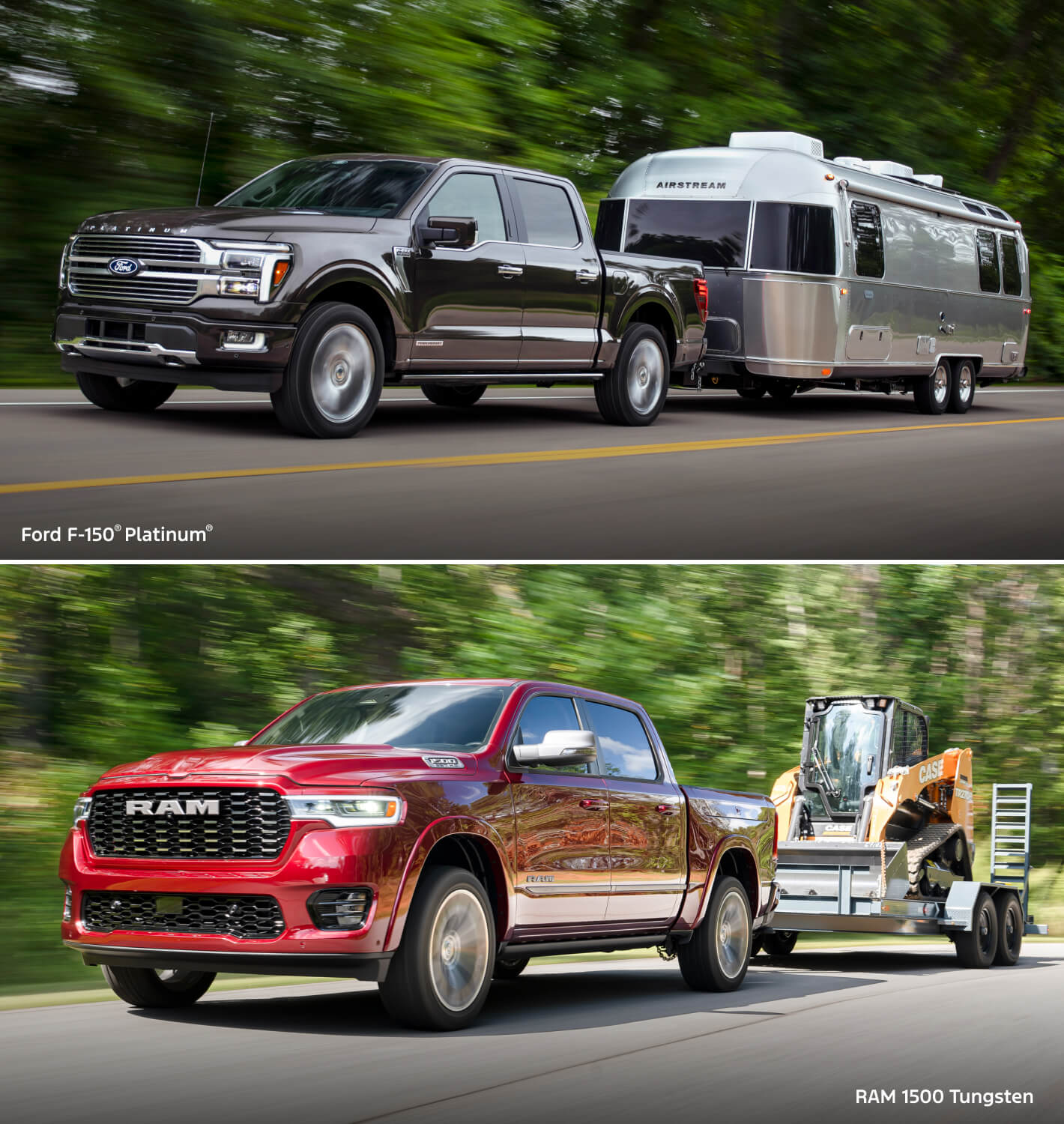
There’s a peculiar kind of electricity that hangs around full-size trucks. It isn’t just the horsepower charts or the glossy brochure photography—it’s the feeling that a single decision can tilt everyday life in a new direction. Park a Ford F-150 beside a Ram 1500, step back, and you can almost hear the debate begin: “Which one is really built for my life?” Most drivers start with surface comparisons—looks, towing numbers, infotainment screens. But the fascination runs deeper. These trucks aren’t simply vehicles; they’re philosophies of work and comfort, translated into steel, engineering, and a distinctive kind of confidence.
So let’s take the long way through the conversation. The Ford F-150 vs. Ram 1500 comparison is rarely only about who wins. It’s about why the matchup captivates, why people return to it like a familiar story they can’t quite forget.
First Impressions: The Look That Starts the Conversation
At a glance, the F-150 tends to project an air of industrious pragmatism. Its stance often feels purposeful, like it expects to be useful the moment the key turns. The Ram 1500, meanwhile, frequently arrives with a smoother visual cadence—more sculpted lines, an emphasis on cabin opulence even when the truck is standing still.
Common observation: people describe the difference in personality. One looks like it belongs on a jobsite. The other looks like it belongs in a weekend getaway photo. But the deeper reason this matters is subtle: our brains read design as intent. When the silhouette suggests capability and the proportions suggest refinement, buyers start to believe—perhaps correctly—that the driving experience will match the vibe.
And once that belief sets in, the test drive becomes more than evaluation. It becomes verification of a narrative: “This truck understands me.”
Engine Lineup and Performance: Power, Response, and the Art of the Pull
Power is where the comparison becomes a sprint, and it’s easy to get trapped in a numbers-only mindset. Yet most drivers don’t measure experience purely by peak output. They measure it by how smoothly the truck responds when merging, when passing, when climbing a grade with a trailer in tow.
The F-150 is typically associated with a broad spectrum of modern engine options engineered for efficiency and flexibility. The Ram 1500 often earns admiration for its torque-centric feel—particularly in configurations that prioritize effortless acceleration under load.
Common observation: one brand “feels stronger” than the other. That impression can come from transmission calibration, turbo behavior, shift logic, and even how the truck dampens noise. The deeper fascination is that modern drivetrains have become orchestras rather than engines. The same claimed horsepower can feel different because the entire system—throttle mapping, driveline ratios, and torque management—plays a role.
When you spend time in each, you learn something surprising: “fast” is not just speed. It’s the absence of hesitation. It’s the sense that the truck is ready before you finish your thought.
Transmission and Drivability: Where Confidence Is Manufactured
Two trucks can share a similar layout on paper and still feel worlds apart in daily driving. That’s because drivability lives in the small details. In one truck, shifts may feel decisive and rhythmically timed. In another, they may feel softer, designed to preserve comfort and reduce perceived harshness.
Common observation: buyers often report different “personalities” at low speeds—how it crawls in traffic, how it edges forward on a steep driveway, how it maintains composure over uneven pavement. These behaviors influence stress. A truck that feels calm when you’re not thinking can become the default partner for everything from errands to hauling chores.
Underneath those impressions sits deeper logic: manufacturers tune the same fundamental mechanisms toward different goals. One may prioritize workday immediacy. The other may aim for smoothness that blurs the boundary between utility and luxury.
Ride Quality and Cabin Comfort: The Battle Between Solidity and Serenity
Full-size trucks are expected to be solid. But solidity isn’t the same as comfort. The Ford F-150 often strives for a balanced ride—firm enough to feel planted, composed enough to remain civilized. The Ram 1500 is frequently praised for an unusually refined cabin experience, where the ride can feel hushed and the surfaces feel intentionally chosen.
Common observation: some drivers describe the Ram 1500’s comfort as “car-like,” while the F-150 retains a more “truck-forward” feel. The deeper reasons for fascination are tied to ergonomics and vibration management. Seat geometry, steering damping, and the way each vehicle isolates road texture all change how fatigue accumulates over time.
On long drives, the winner often becomes the truck that keeps your body feeling coherent—neck relaxed, back supported, hands steady. That’s not marketing. That’s physiology negotiating with suspension design.
Towing and Hauling: The Real Test After the Photos
Eventually, the conversation turns to what happens when the bed is full, when a trailer needs to follow, when the work stops being hypothetical. Towing and payload capability are crucial, but so is tow manners: stability, braking feel, steering authority, and how the truck behaves when loaded unevenly.
The F-150 is often chosen by drivers who want a strong suite of towing technologies and flexible configurations for different hauling scenarios. The Ram 1500 is frequently selected by those who want confidence without sacrificing comfort—especially when long highway stretches turn the tow into a prolonged experience rather than a one-time event.
Common observation: “Both can tow, but one feels less strained.” That “less strained” sensation may come from how systems manage torque, how the suspension resists squat, and how the cabin remains composed under load. The deeper fascination is why towing feels emotional. People remember the first time they confidently backed a trailer into a tight space or descended a grade without white-knuckling.
Technology and Infotainment: Convenience as a Form of Control
Modern trucks increasingly function as rolling command centers. Navigation, smartphone integration, voice control, and driver-assistance features don’t just entertain. They reduce friction—less time fiddling, more time moving.
Both the F-150 and Ram 1500 typically offer advanced infotainment experiences, with each brand leaning into its own interface style and feature philosophy. Some drivers prefer one system’s clarity and menu flow. Others appreciate the second’s responsiveness and how quickly functions can be accessed.
Common observation: “The screen is nice, but the real win is how fast it works.” The deeper reason this matters is cognitive load. A truck that makes tasks feel instantaneous gives drivers more mental bandwidth. When stress drops, driving becomes smoother, and even minor discomfort feels less significant.
Safety and Driver-Assist Features: Predictability in Motion
Full-size trucks spend a lot of time sharing roads with unpredictable variables—nightfall, weather changes, inattentive drivers. Safety systems can transform that uncertainty into predictability.
Both vehicles often come equipped with a range of driver-assistance technologies, including adaptive cruise-style functions, lane-centering support, collision mitigation, and monitoring features that encourage attention without being intrusive.
Common observation: drivers say the trucks “feel more aware.” The deeper truth is that awareness can be engineered. Sensors detect patterns earlier than humans do, but good calibration matters—intervening at the right moment, maintaining stability rather than causing distraction.
Trim Levels and Personalization: Choosing a Lifestyle, Not Just a Vehicle
One of the most overlooked aspects of the F-150 vs. Ram 1500 debate is how trim levels shape identity. A base configuration may prioritize value and capability. Higher trims often emphasize creature comforts, premium materials, and a fuller suite of technology.
Common observation: “I didn’t expect the trim to matter this much.” It does, because your daily routine is the real spec sheet. If you commute, the steering feel and noise insulation matter. If you haul, the towing tech and suspension calibration matter. If you often travel, the seats, climate system, and infotainment flow matter.
The deeper fascination is that both nameplates can be tuned to match a personality—workmanlike, adventurous, refined, or somewhere gloriously in between.
Fuel Economy and Efficiency: The Hidden Cost of Driving
Fuel economy isn’t just about saving money. It’s about range, planning, and the mental comfort of fewer stops. Modern powertrains and drivetrain technologies increasingly aim to make efficiency feel effortless, whether through intelligent engine management or optimized gear ratios.
Common observation: real-world results vary, even with similar driving styles. That’s because efficiency depends on load, terrain, temperature, tire condition, and how aggressively the throttle is used. The deeper reason the comparison persists is that efficiency isn’t a single number—it’s a relationship between power demand and how the truck responds.
So, Which One Wins? The Answer Depends on Your Definition of “Battle”
The Ford F-150 vs. Ram 1500 matchup rarely produces a clean knockout. Instead, it creates a choice between different strengths. The F-150 often appeals to drivers who want a capable, adaptable truck with a broad toolset and a work-ready temperament. The Ram 1500 often attracts those who prioritize refinement, comfort, and a confident ride that remains composed under everyday pressures.
The common observation is that one truck “wins” on paper. But the deeper reasons people keep coming back are human. They want a vehicle that feels like a reliable extension of their routine. They want the day-to-day to be smoother, safer, and more rewarding—whether that means cruising to a jobsite, towing a weekend project, or simply turning a mundane errand into something less ordinary.
Final Thoughts: The Fascination Is the Point
In the end, the full-size truck battle isn’t just competition—it’s clarity. It forces you to articulate what matters: how you drive, what you carry, how you measure comfort, and what kind of confidence you need when the road changes without warning.
And once you understand that, the “battle” becomes less about choosing a brand and more about selecting a companion for motion—one that fits your life’s rhythm, echoes your priorities, and keeps the momentum going long after the test drive ends.