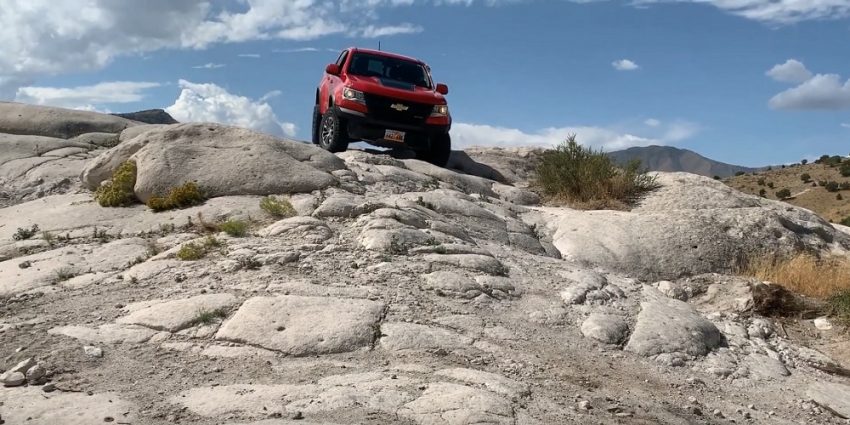
Ever wondered what happens when a rugged pickup meets a landscape that looks like it was carved by time itself? Imagine sandstone cathedrals, sun-bleached ruts, and switchbacks that demand respect. Now picture the Chevrolet Colorado ZR2 showing up with a grin—ready to dance with the sand and wrestle the rock. But here’s the playful question: can it keep its composure when the trail stops being polite and starts being downright theatrical?
There’s a challenge lurking in the background of every Moab day: traction that arrives late, climbs that feel steeper than they look, and off-camber moments where confidence can evaporate in a single heartbeat. The Colorado ZR2 doesn’t merely “handle” this kind of terrain. It courts it. And as the trail tightens its grip, the question becomes less about whether the truck will make it—and more about how it feels while doing so.
Moab, Where the Terrain Writes Its Own Script
Moab is not a theme park. It’s an open-air workshop where geology performs every trick in its repertoire. One moment you’re gliding over compacted gravel. The next, you’re threading through deep ruts that seem engineered for mischief. The air is thin enough to sharpen your senses; the light is bright enough to reveal every irregularity in the ground.
In this environment, a pickup’s character is tested at the micro level. Not just clearance, not just power—though both matter. It’s also about how predictably the truck responds when the surface turns whimsical. A trail can change under your tires within a few meters. That’s why a ZR2 doesn’t simply need capability; it needs communication.
And communication starts before the first obstacle. Tire choice, ride height, driver confidence, and the truck’s electronics working in concert all determine whether the day feels like a guided journey or an unplanned improvisation.

The ZR2 Stance: Built for Clearance, Tuned for Confidence
The Colorado ZR2 arrives with a stance that doesn’t whisper—it announces. Lifted geometry helps it approach obstacles without the constant fear of scraping. Skid protection adds a layer of mental calm; you feel less like you’re negotiating with the underbody and more like you’re exploring the trail on purpose.
Moab’s rocky textures can be abrasive in both a physical and emotional sense. When you’re bouncing over uneven stone, a suspension setup must do more than absorb impact. It must keep the tires planted long enough for traction systems to do their job. If the tires lose contact too easily, control becomes a gamble.
The ZR2’s engineering aims to keep the wheels engaged even as the trail tries to separate rubber from reality. Long-travel behavior, stable damping, and a suspension that feels composed over repeated impacts all matter—especially when you’re transitioning from small rocks to larger ledges.
Tire Contact and Sidewall Storytelling
Off-road traction is less about raw grip and more about tire “conversation” with the ground. Sidewalls flex. Treads bite. Gravel packs into grooves. Sand rolls into patterns. Every surface asks the tires to respond differently.
On Moab’s mixed terrain, the Colorado ZR2’s tire performance becomes evident in subtle ways. When you crest a ridge and the front end unloads slightly, the truck must regain composure quickly as weight transfers back down. When you enter a sandy patch, you want to avoid spinning yourself into a rut. When you encounter loose rock, you want controlled slip rather than frantic wheelspin.
This is where driver technique meets vehicle intelligence. The ZR2 invites a steady rhythm—inputs that are smooth enough to be interpreted accurately by the drivetrain and stability systems.
Climbing: When Torque Meets Gravity
Climbing in Moab is where bravery becomes engineering. Some sections are steep but predictable. Others are steep and unpredictable, with shifting loose stone that can turn a solid foothold into a sliding suggestion.
In a trail test, the most important question isn’t simply “Can it go up?” It’s “Can it go up without turning into chaos?” The Colorado ZR2’s power delivery and traction management work together to maintain momentum while protecting the understructure from abrupt impacts. You feel the truck modulate effort instead of lurching toward wheelspin.
On steep grades, the drivetrain’s ability to provide steady torque is crucial. Steady torque prevents you from overcorrecting. It helps the tires keep a consistent bite. And in a landscape that punishes sudden changes, consistency becomes a superpower.
Even as the wheels fight for grip, the ZR2’s throttle response stays legible. That matters. A truck that feels “mushy” under load can turn a climb into a question of guesswork. The Colorado ZR2 aims for clarity—giving the driver confidence to place each pedal input like a brushstroke.
Descending: The Art of Controlled Breathing
What goes up must come down, and Moab’s descents often feel steeper than their angle suggests. Gravity accelerates everything, including small mistakes. The goal is not to brake harshly at every moment. The goal is to decelerate smoothly, maintain balance, and keep tires aligned with the path.
The ZR2’s off-road control systems help manage speed so the driver can focus on steering and line selection. When you’re navigating rock steps or uneven drops, controlled deceleration reduces shock loads on suspension components. It also keeps traction available for steering rather than exhausting it just trying to slow down.
Long descents test endurance and consistency. The best off-road descents feel like a slow exhale rather than a hard stop. If the truck holds a stable pace, the trail stops feeling like a threat and starts feeling like an experience.
Articulation and Rock Play: Where Suspension Becomes Poetry
There are moments on Moab trails when the ground refuses to be level—when one wheel hangs in a pocket while the opposite side rides higher. This is where articulation matters. A truck that can keep contact on multiple wheels maintains traction across uneven terrain.
In a ZR2 trail test, articulation isn’t just a spec. It’s the difference between “we might make it” and “we’re driving it.” When the suspension cycles effectively, the truck handles off-camber sections with less drama. The steering feels less skittish. The chassis feels more settled, even when the trail becomes a rollercoaster of rock.
Those rock-play moments can be delightful. Long enough to grin, dramatic enough to respect. And short enough that you’re left wanting one more run.

Electronics and Driver Control: The Balance of Help and Responsibility
Off-road electronics can be a safety net, but only if they remain predictable. The Colorado ZR2’s systems aim to assist without stealing the driver’s agency. Traction and stability management should respond to changing slip conditions while allowing controlled movement—like guiding a horse without yanking the reins.
A successful Moab day involves choosing the right level of assistance. Too much intervention can limit wheelspin in situations where controlled slip would help. Too little can lead to unproductive spinning. The challenge is to find the sweet spot where the truck’s capabilities and the driver’s intent align.
That alignment shows up in the flow. Smooth lines. Thoughtful throttle. Steering that feels connected instead of delayed. When the electronics and mechanical components work together, the entire experience feels cohesive, almost choreographed.
The Final Challenge: Can It Stay Playful Under Pressure?
Here’s the Moab verdict that matters most: after climbs, descents, ruts, and rock gardens, does the Colorado ZR2 still feel like it wants to play? Or does it begin to feel strained, skittish, and uncertain?
A trail test reveals the truth quickly. The truck should remain composed over successive obstacles, not just excel at a single highlight. Cooling, brake consistency, steering steadiness, and suspension control all contribute to how the final stretch feels.
If the Colorado ZR2 maintains its composure, then the playful question has an answer. Not just “Can it do Moab?” but “Can it do Moab repeatedly—with confidence intact?”
Out on the Trail: A Moab-Ready Character
By the time dust settles and the sun starts to soften, the Colorado ZR2 leaves behind more than tire marks. It leaves a sense of capability with restraint. It’s not an overconfident showpiece; it’s a tool with personality—one that thrives when the trail grows teeth.
Moab is the kind of place that turns vehicles into stories. The Chevrolet Colorado ZR2 adds a chapter that’s about control, traction, and a surprisingly calm rhythm amid chaos. And when the last obstacle disappears behind you, the real satisfaction isn’t just completion—it’s the feeling that the trail was met on its own terms.