At first glance, the Subaru Solterra and the Toyota bZ4X can feel like mirrors. Same EV cadence, same compact-SUV silhouette, same all-wheel-drive promise for drivers who crave traction when weather turns theatrical. Yet there’s a recurring observation among shoppers and enthusiasts: two “twin” cars can still feel oddly different once the road begins to speak.
This isn’t just brand folklore. It’s the subtle interplay of engineering intent, cabin psychology, and how each manufacturer interprets everyday life. On paper, the match-up reads as an identical chessboard. In reality, each move is played with a distinct temperament.
That tension—between sameness and personality—is exactly why people remain fascinated. It’s less about picking the “better twin” and more about discovering how the same technological skeleton can wear different expressions.
AWD Twins, Different Visions: The Immediate Impression
Both vehicles arrive with AWD confidence, a feature that has become less a luxury and more a baseline expectation for winter-facing regions. The moment you step in, you notice the first fork in the road: layout preferences, tuning philosophies, and even how controls are arranged to shape driver behavior.
Commonality matters, but so does emphasis. The Solterra often feels a touch more grounded—an impression reinforced by how the suspension and steering responses are transmitted through the seat of the pants. The bZ4X, meanwhile, tends to project a more neutral, efficiency-minded demeanor. Short bursts of movement feel tidy and deliberate, as if designed to minimize distraction.
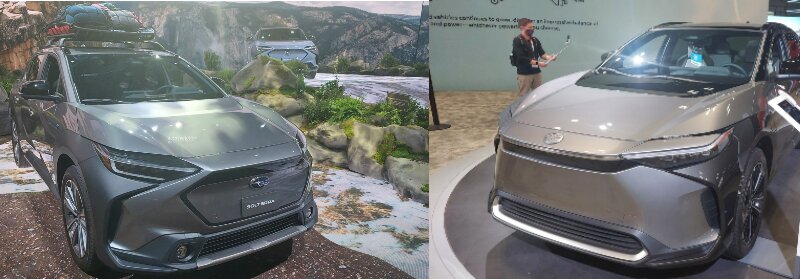
It’s the same platform energy, but the software and calibration decisions act like different conductors. The instruments—motor, battery, drivetrain—are closely related. The orchestration is not.
Under the Skin: Shared Architecture, Divergent Calibration
The shared underpinnings create a fascinating kind of paradox. When two cars share key components, many shoppers expect outcomes to match: similar acceleration, comparable range, and parallel handling character. But EVs behave like ecosystems rather than machines.
Temperature management, power delivery curves, traction control logic, and regen behavior all influence what drivers perceive as “feel.” Regen braking is especially revealing. Adjust how strongly the vehicle slows during deceleration, and the whole rhythm of driving changes. One twin can encourage smooth, gliding deceleration, while the other invites a more assertive, frictionless narrative.
Even when efficiency targets are shared, the manner in which energy is reclaimed can shift real-world results. A small difference in throttle mapping—how the pedal translates into torque—can make a car seem either eager or calm. That “eagerness” is often what converts curiosity into commitment.
Range and Real-World Efficiency: The Numbers vs the Experience
Range is the headline, but experience is the headline’s shadow. Drivers commonly observe that twins can show similar estimated range figures, yet arrive with different satisfaction levels once daily driving begins.
Why? Because efficiency is not a single metric. It’s a compound outcome of tire choice, thermal strategy, vehicle weight distribution, and how each car handles aerodynamic wake turbulence at highway speeds. Small differences in wind resistance can create outsized impacts once you’re driving at velocity—where air behaves less like atmosphere and more like a variable load.
There’s also the matter of driving style. In AWD EVs, torque distribution can influence tire slip and correction events. Those micro-interactions—imperceptible to spreadsheets—show up as changes in how “effortless” the car feels on a commute.
In other words, one twin may feel more “economical” even if the raw figure is close. The mind translates smoothness into savings.
Charging Behavior: Predictability Is a Feature
Charging is where optimism can become reality quickly. Drivers learn the hard way that peak charging rates are not constant companions. Battery temperature, charger capability, and state-of-charge at arrival all determine how your session unfolds.
Both models rely on thermal management strategies that aim to keep the battery within a workable window. But predictability matters. A vehicle that consistently preconditions—especially during navigation-assisted route planning—tends to reduce the mental tax of uncertainty. That emotional comfort can be as valuable as a few kilowatt-hours gained.
Subaru’s approach often feels like it respects practical planning. Toyota’s approach often feels like it leans into mainstream convenience. Both can be effective; their differences are about the way they anticipate your next stop.
Ride, Steering, and the AWD Personality
AWD doesn’t just add traction. It adds a personality. The AWD system shapes how torque is allocated under changing grip conditions—wet asphalt, loose gravel, slushy corners. That allocation affects vehicle rotation, driveline feel, and how the chassis communicates compliance.
The Solterra can feel fractionally more tactile, with a sensation of confidence during uneven surfaces. The bZ4X may feel more composed in a straight line, like a quiet assistant that keeps you on course. Neither is wrong. They’re just different interpretations of what “control” should feel like.
And then there’s steering response. Some drivers like steering that seems to “arrive” quickly at the commanded angle. Others prefer a slightly calmer progression. These preferences can become deciding factors because steering is the language through which drivers negotiate with curves.
Cabin Atmosphere: Design as a Driving Mood
Inside, the twins diverge further than many expect. Materials, ergonomics, and interface layouts subtly affect fatigue. A cabin that reduces glare, places controls where the hand naturally wants to land, and communicates driver intent through clean displays tends to feel more effortless over long trips.
The Solterra’s cabin often gives off an outdoors-adjacent clarity, aligning with Subaru’s historic relationship to messy environments and long drives that start with optimism. The bZ4X often feels like a tech-forward lounge—still practical, but calibrated toward everyday ease and a “plug-and-play” vibe.
These aren’t superficial choices. They are psychological engineering. The cabin is where you decide whether an EV is a temporary experiment or a long-term companion.
Technology and Driver Assistance: Trust vs Intrigue
Driver assistance systems sit at the crossroads of trust and intrigue. Some users want predictability: lane centering that behaves consistently, adaptive cruise that feels smooth, alerts that don’t feel like nagging. Others enjoy the subtle ways systems adapt to context.
Even with broadly similar capabilities across the twins, implementation details can influence perceived confidence. How soon the system reacts, how it handles edge cases, and how it communicates limitations can reshape the whole experience.
In day-to-day use, the most important trait is not the technology’s headline. It’s whether the car helps you relax.
Pricing and Ownership Reality: Where the Twins Stop Being Identical
Price is often treated like a final verdict, but it’s really a gateway to ownership calculus. Differences in trims, incentives, and accessory bundles can shift the real cost. The “value” equation also depends on insurance premiums, charging habits, and how often you use features you can’t ignore—like heated seats, navigation guidance, or advanced driver assistance.
One twin might draw shoppers with a slightly more attractive entry point. The other might win with the feeling of completeness at a given configuration level. Those are not trivial distinctions; they influence how likely you are to recommend the car to a friend.
EV ownership is less about buying a machine and more about adopting a routine. Whichever twin best fits your routine will feel like the better buy—even if the cars share more DNA than you expected.
Why the “Twin” Concept Still Fascinates
The deeper fascination lies in the contrast between shared constraints and creative decisions. A common chassis sets limits, but it also invites interpretation. Manufacturers can tune the same hardware to produce different emotional outcomes.
It’s also a lesson in perception. People don’t just evaluate performance. They evaluate intention—how the car seems to understand them. The Solterra and bZ4X demonstrate that engineering is not destiny. It’s a foundation. The rest is an editorial choice.
That’s why drivers keep returning to the question: not “which is better,” but “which feels right.” The answer often changes with weather, roads, and daily habits. Sometimes the twin you didn’t expect becomes the one you keep thinking about.
Conclusion: Choosing Your AWD EV Twin
Subaru Solterra vs Toyota bZ4X is a matchup built on shared architecture and diverging character. Both offer the security of AWD and the promise of EV simplicity. Yet they differ in calibration nuances, cabin atmosphere, technology delivery, and the emotional texture of everyday driving.
If you value rugged clarity and a grounded, outdoors-inclined presence, the Solterra may resonate. If you prefer mainstream tech comfort and a calm, efficiency-forward vibe, the bZ4X can feel more natural.
Either way, the experience becomes more than a purchase. It becomes a study in how two “twins” can still tell separate stories—through the same fundamental language of electricity and motion.